The AI Growth Engineer for Mobile Apps
Analytics tells you where your users left. Wire runs experiments to keep them.
You paid for every install. The first session decides who stays, and testing it is a full-time job.
A narrated walk through Wire running the journey, from observe to act.
01/The leak
You already paid for the users who left.
Every install came out of your ad budget. Most are gone within a month, and the ones who left cost exactly the same as the ones who stayed. That gap is the one number on this page you can compute yourself.
€3,000 spent · €2,100 walked out
Put your own install cost in and the arithmetic does not get friendlier.
02/How it works
A/B testing, reimagined with AI.
Agencies and product teams already do this, by hand. Gather the data, argue about what to change, write one alternative, ship it, then wait for enough traffic to call it. Start again on the next screen.
Wire runs the same loop without waiting on anyone. It reads what it already knows about your app and the people using it, puts four versions of a step live instead of one, watches how real users move through them, and keeps the one that holds. Then it moves to the next stage of the journey.
A, B, C and D are those four versions. Nothing is written live for a user, and everyone keeps the version they were given.
Swipe the table sideways to see all four variants
Four tested surfaces, four ways through each, plus the engine step that personalizes the start.
A user picks "sleep better" in their first session. Wire routes them to the fastest first win. The in-app review ask moves to the moment right after that win lands, instead of on app open.
Then the loop closes.
The winning arm becomes the new baseline. The next experiment starts from there, and the arm you keep is a static config, so it behaves the same way every time.
Sign up free03/Proof
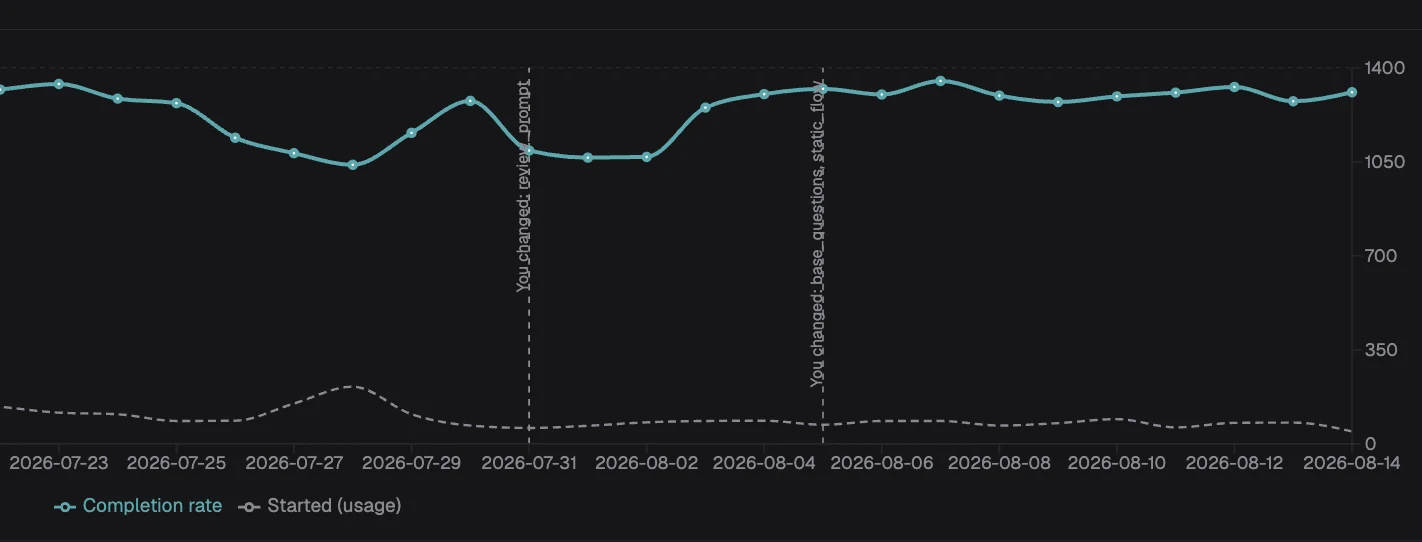
One production app, same two weeks, same traffic. I ran it myself.
Across the whole user journey.
In users, in just 2 weeks. Same app.
04/Where this ends up
Analytics stops at the chart.
One hands you a chart, one hands you a ticket, Wire hands you a winner.
You write the variants, the tool runs the stats, a person reads the chart and decides.
PostHog, Amplitude.
They read the data and hand you a ticket describing a fix. Nothing ships.
The variants are generated for you across the journey, they run on real users, and the winner is already live.
Analytics tells you where your users left. Wire tests four ways to keep them.
Analytics free to 299k events/month. Forever. Any app.
05/Plans
Three plans. Nothing charges yet.
A variant is one version of one journey stage.
A learning loop is one experiment run to a winner.
A learning report is your write-up of a loop, pushed back through the MCP server.
Analytics free to 299k events/month. Forever. Any app.
Variant, learning loop and event quotas for one app.
Higher variant, learning report and event quotas.
Nothing is charging today. Early adopters get 2 months free, then 40% off Starter and Pro until the end of the year. I will tell you before anything is charged.
Founding cohort: 15 seats
06/FAQ
The six things developers ask me first.
SDK docs, MCP setup, boilerplates and integration guides live under Docs.
Where your data lives
Fly.io, primary region Frankfurt, Germany, EU. The model in production is OpenAI gpt-4o-mini. End-user answers reach the provider. Review and questionnaire free text does not.
Whether it is App Store safe
Native React Native components, shipped inside your binary. No WebView. No remote code download. Once the SDK is integrated, experiment config is delivered through it, which is a mechanical detail rather than a selling point.
What happens when Wire fails
Wire retries, then degrades to the static base questions, so the user always finishes the flow.
What happens when you stop paying
You keep the winning config. It is static, so it is just your setup, and it keeps running in your app.
How long the install takes
One install gives you events, funnels and session transcripts, readable by your AI tools over MCP. Signup is self-serve: an app name in, a working API key out. The AI experimentation pieces are switched on by hand today, with me.
Whether it is React Native only
React Native and Expo first. That is where it is tested.